

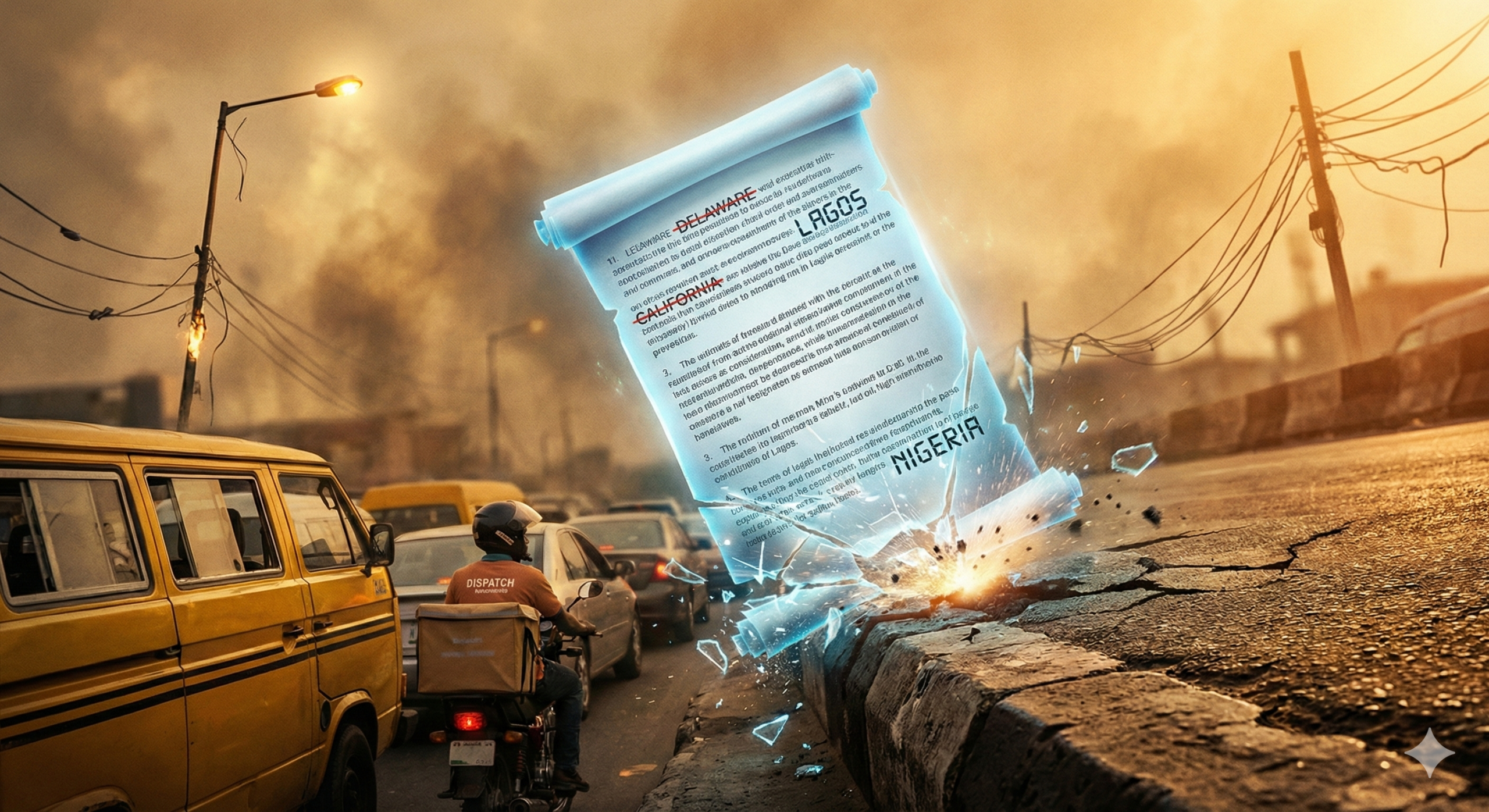
“Your T&Cs are doing ‘copy and paste’ from Silicon Valley, but your customers are in Oshodi. One refund fraud case and your ‘Terms’ will be speaking English while your bank account is speaking tears”.
Everyone is a founder these days, and as a Nigerian founder, your “To-Do” list is longer than the queues at the Third Mainland Bridge during rush hour. Your problems are endless; you’ve got product-market fit to find, dispatch riders to chase, and a business to scale.
So, when it came time for that “Terms & Conditions” page, you did what 90% of us do: You went to a random US-based SaaS or e-commerce site, hit Ctrl+C, changed “Delaware” to “Lagos”, and hit Ctrl+V.
My Leader, we need to talk.
Copying your T&Cs from a US website isn’t just “soft work”—it’s a legal time bomb. You are basically inviting “smart” customers to help you spend your money; o por, it’s plenty abi.
That seemingly harmless document you found on a quick Google search could easily cost your Nigerian business everything by exposing you to foreign loopholes, unenforceable clauses, and the kind of wahala a properly localised document prevents.
In this land of myth and this time of magic, your fine print is the only thing standing between you and a refund request that will make you question your life choices.
Your “Copy-Paste” strategy is a trap, and here’s how to fix it before the FCCPA (Federal Competition and Consumer Protection Act) comes knocking.
- In the case of “No Refunds” vs. The FCCPA.
In the US, many states have “No Refund” policies that are as stiff as a board. If you copy those, you might think you’re safe. But wait—have you met the Federal Competition and Consumer Protection Act (FCCPA) 2018?
Nigeria really took the consumer is king, very literally; the FCCPA is their palace guard. If your copied T&Cs say “Strictly No Refunds”, but the customer receives a shirt that looks like a floor rag instead of the “Premium Italian Silk” you promised, your T&Cs are useless. Yes, I’m talking about all the what I ordered v what I got. You people should change o, it’s a new year.
Don’t just say “No Refunds”. Define the “Conditions for Rejection”. i.e state clearly that returns are only accepted if the seal is unbroken or if the defect is reported within 24–48 hours.
Use the FCCPA to your advantage by outlining a clear “Cure Period”—where you get to fix the issue before they demand a refund. - Liability Limits: Because “Dispatch Rider Wahala” is Real.
A US-based T&C template assumes the postal service actually works. It doesn’t account for a dispatch rider getting stuck in Third Mainland Bridge traffic for hours or “network issues” that are everywhere you go, from a Nigerian bank making payments disappear into the “floating” abyss.
If your T&Cs don’t explicitly limit your liability for third-party failures (logistics, payment gateways, or ISP downtime), you are legally responsible for things you can’t control.
Your liability clause should explicitly mention:
Force Majeures (The “Act of God” Clause): Include “protracted network failure” (let’s not name green names), “government-imposed internet restrictions”, and yes, even “unforeseen civil unrest” (the aloota people).
Delivery Timelines: Clearly state that “Estimated Delivery” is exactly that—an estimate. Don’t let a customer sue you for “emotional distress” because their Jollof Rice arrived cold due to a protest. - Jurisdiction: Stop Flying to Delaware in Your Dreams
Nothing is funnier (and sadder) than seeing a Nigerian startup with a T&C page that says, “Any disputes shall be settled in the courts of the State of Delaware.”
My brother, if a customer in Onitsha decides to sue you for a 50k refund, are you going to fly to Delaware?
By including a foreign jurisdiction, you make your contract potentially unenforceable in a Nigerian court, or worse, you give any reasonable lawyer a loophole to make light work of you and drag you through expensive legal proceedings.
Keep it local.
That’s why experts like Maestrotouch Legal, a virtual Nigerian law firm, always insist on a clause that explicitly states that the agreement is governed by the Laws of the Federal Republic of Nigeria.
Mention that disputes should first be settled via Mediation or Arbitration in [Your City] before any court action. This saves you from the “Oya, let’s go to court” warriors. - SaaS Founders: Uptime Promises
For SaaS founders, copying a 99.9% uptime SLA (Service Level Agreement) from a Silicon Valley giant is a suicide mission. Between undersea cable cuts and local hosting “glitches”, 99.9% is a tall order.
Build “The Nigerian Factor” into your SLA.
Define what constitutes “Downtime.”
State that maintenance windows (especially during those 2 AM “NEPA” moments) don’t count against your uptime.
Limit your refund liability to the amount paid for the current billing cycle—not the “potential profit” the customer lost while your app was down.
Our Founder’s T&Cs Checklist.
Don’t wait for a “Demand Letter” to arrive. Check these five things right now:
[ ] Jurisdiction Check: Does your page mention “Delaware”, “California”, or “England”? If yes, change it to “Federal Republic of Nigeria” immediately.
[ ] The “Naija Factor” Clause: Do you have a section covering network failure, ISP downtime, and logistics delays?
[ ] Refund Windows: Have you defined exactly how a customer should report a defect (e.g., “photo evidence within 12 hours”)?
[ ] Arbitration First: Did you include a clause that requires mediation before anyone can sue you?
[ ] No “Absolute” Promises: Replace words like “Guaranteed 24-hour delivery” with “Targeted 24-hour delivery”.
Conclusion: Protect Your Hustle
Your Terms & Conditions shouldn’t just be a boring page or, even worse, an adversary. It should safeguard the interests of your business.
Copy-pasting from the US is like wearing a hoodie in the middle of a Lagos heatwave—it looks out of place, and it’s going to make you sweat. Customising your fine print isn’t just about legal “jargon”; it’s about protecting your cash flow and ensuring your business survives the unique “wahala” of the Nigerian market.
Ready to stop the “stories that touch“? It’s time to audit that “Boring Page”, and maybe check if that sweet-sounding free contract template could cost your Nigerian business everything. Even better, make sure you’ve clarified if your side hustle is legally a business in the first place! Your bank account will thank you later.
“Disclaimer: This article is for informational purposes and does not constitute formal legal advice. For specific contracts, please consult a legal professional who knows the difference between a pair of briefs and “briefs”.

This is quite educating.